


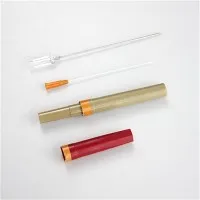
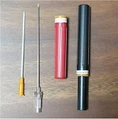



The manual suction device mainly changes the pressure inside the device through manual operation to produce a suction effect. This process uses the principle of air pressure difference or fluid flow dynamics inside the pump body to make the gas or liquid flow and generate negative pressure or positive pressure.
Many manual suction devices use the piston principle. For example, when the piston is lifted manually, the space inside the pump body will increase, forming a low-pressure area. According to the principle of pressure difference, the gas or liquid from the outside will be pressed into this low-pressure area, and when the piston is pressed down, the inhaled gas or liquid will be discharged, thereby realizing the suction process. This is similar to the working method of the syringe. When the push rod of the syringe is pulled outward, the pressure in the syringe decreases, the liquid medicine will be sucked in, and when the push rod is pushed in, the liquid medicine will be discharged.
There are also some manual suction devices that use the diaphragm principle, such as the manual diaphragm pump. It relies on the deformation of the elastic diaphragm to achieve suction. When the diaphragm moves upward, the volume of the pump chamber increases, the pressure decreases, and the medium is sucked in; when the diaphragm moves downward, the pressure increases and the medium is discharged. The diaphragm is like a deformable valve, which continuously changes the pressure state inside the pump body through its own elastic deformation, thereby realizing the process of gas or liquid suction. This structure is widely used in many infusion and aspiration devices, because by selecting diaphragms with different elasticity and materials, different media and different suction pressure requirements can be met.
Like some manual vacuum pumps, the internal pressure of the container from which the air is extracted is reduced to a state below atmospheric pressure by physical means to achieve vacuum extraction. It is generally composed of a suction pipe, a pump body, a pump rod and other components. During manual operation, the pump rod moves up and down, so that the gas in the pump body is continuously discharged through the suction pipe, forming a low-pressure area, and the gas in the container is continuously extracted to achieve the purpose of a vacuum state.