




Stretchability is a crucial property when it comes to gauze rolls, especially in various medical, industrial, and household applications. As a supplier of high - quality gauze rolls, I have witnessed firsthand the importance of understanding the stretchability of these products.
Understanding Stretchability
Stretchability refers to the ability of a material to be stretched or extended without breaking. In the context of a gauze roll, it is the measure of how far the gauze can be pulled before it tears. This property is determined by several factors, including the material composition, weave pattern, and manufacturing process.

Material Composition
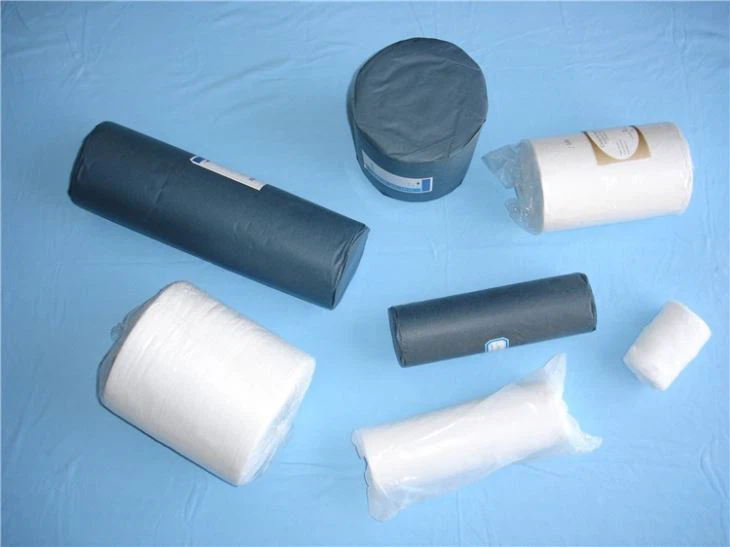
The material used to make a gauze roll plays a significant role in its stretchability. For instance, 100% Cotton Gauze Roll is a popular choice due to its natural fibers. Cotton has some inherent stretchability, but it is also relatively strong. The long, staple fibers of cotton allow the fabric to stretch to a certain extent and then return to its original shape. This makes it suitable for applications where a gentle stretch is required, such as wrapping wounds or securing dressings.
On the other hand, Non - woven Gauze Rolls are made from synthetic fibers or a blend of synthetic and natural fibers. Non - woven materials are typically less stretchy than woven cotton gauze. They are often designed for specific functions, such as providing a barrier or absorbing fluids. The lack of a traditional weave pattern means that they do not have the same natural stretch as woven materials. However, some non - woven gauze rolls can be engineered to have a certain degree of stretch through the use of elastic fibers or special manufacturing techniques.
Weave Pattern
The weave pattern of a gauze roll also affects its stretchability. A simple plain weave, where the warp and weft threads cross over each other in a regular pattern, generally has less stretch than a more complex weave. For example, a twill weave, which has a diagonal pattern, can provide more stretch in one direction compared to a plain weave. This is because the diagonal pattern allows the threads to move more freely when stretched.
In addition, the tightness of the weave can impact stretchability. A tightly woven gauze roll will have less stretch than a loosely woven one. A loose weave allows the threads to move and slide past each other more easily, resulting in greater stretchability. However, a very loose weave may also compromise the strength of the gauze.
Manufacturing Process
The manufacturing process can further influence the stretchability of a gauze roll. During the production, the fibers can be treated with chemicals or heat to enhance their stretch properties. For example, some manufacturers use a process called heat - setting to fix the shape of the fibers and improve their stretch and recovery characteristics.
Another factor is the way the gauze is wound onto the roll. If the gauze is wound too tightly, it can restrict its stretchability. A proper winding technique ensures that the gauze can be easily unwound and stretched without excessive resistance.
Importance of Stretchability in Different Applications
Medical Applications
In the medical field, the stretchability of a gauze roll is of utmost importance. When used for wound dressing, a stretchable gauze can conform to the shape of the wound, providing a better fit and reducing the risk of the dressing coming loose. It can also be stretched to cover larger areas without tearing, which is particularly useful for wounds on irregularly shaped body parts.
For example, in orthopedic applications, a stretchable gauze can be wrapped around a cast or splint to provide support and stability. The stretch allows the gauze to be tightened or loosened as needed, ensuring a comfortable and secure fit for the patient.
Industrial Applications
In industrial settings, gauze rolls are often used for cleaning, polishing, and filtering. A stretchable gauze can be more easily manipulated to fit into tight spaces or around complex objects. For instance, in the automotive industry, stretchable gauze can be used to clean hard - to - reach areas in engines or to polish delicate parts.
Household Applications
At home, gauze rolls are commonly used for first - aid purposes, as well as for crafts and DIY projects. A stretchable gauze can be used to wrap injuries, make bandages, or even for creative applications such as making fabric flowers or decorations.
Measuring Stretchability
There are several methods to measure the stretchability of a gauze roll. One common method is the tensile strength test. In this test, a sample of the gauze is clamped at both ends and pulled until it breaks. The amount of force required to break the gauze and the distance it stretches before breaking are measured.
Another method is the elongation test, which measures the percentage of stretch that the gauze can achieve without breaking. This is calculated by comparing the original length of the gauze to its length after it has been stretched.
Our Gauze Rolls and Stretchability
As a supplier, we understand the importance of providing gauze rolls with the right stretchability for different applications. Our 100% Cotton Gauze Roll offers a good balance of stretch and strength. The natural cotton fibers provide a gentle stretch that is suitable for medical and household use.
Our Non - woven Gauze Rolls are engineered to meet specific requirements. Depending on the application, we can offer non - woven gauze with different levels of stretchability. For example, some non - woven gauze rolls are designed to be more stretchy for applications where flexibility is needed, while others are more rigid for applications where a firm barrier is required.
Conclusion
The stretchability of a gauze roll is a complex property that is influenced by material composition, weave pattern, and manufacturing process. Understanding the stretchability of gauze rolls is essential for choosing the right product for different applications. Whether it is for medical, industrial, or household use, a stretchable gauze can provide better performance and functionality.
If you are interested in purchasing high - quality gauze rolls with the right stretchability for your specific needs, please feel free to contact us for a detailed discussion. We are committed to providing the best products and services to meet your requirements.
References
- ASTM International. (Year). Standard test methods for tensile properties of textiles. ASTM D5034.
- Textile Institute. (Year). Handbook of textile testing.